Jessica
At WeLovePetz, we are dedicated to providing you with the best pet care tips.
🧪 The ‘Truth’ Test
If you have raised a kitten, you know the biggest headache isn’t the scratching—it’s the litter box. Kittens have incredibly sensitive stomachs, and “transition diarrhea” is a nightmare to clean up.
I switched a litter of 4-month-old fosters onto this Royal Canin formula to see if the reputation held up. The results were immediate. Within 48 hours, the loose stools that had plagued two of the kittens completely firmed up. I didn’t have to add pumpkin puree or probiotics; the food did the heavy lifting on its own.
While I have issues with some of the ingredients (which I’ll get to below), I can’t argue with the results in the litter box. If your primary goal is a stable tummy and predictable cleanup, this formula works.
🏗️ Build & Design Audit
When we talk about the “build” of cat food, we are looking at the kibble engineering and the ingredient composition.
The Kibble Mechanics
[Image of cat digestive system]
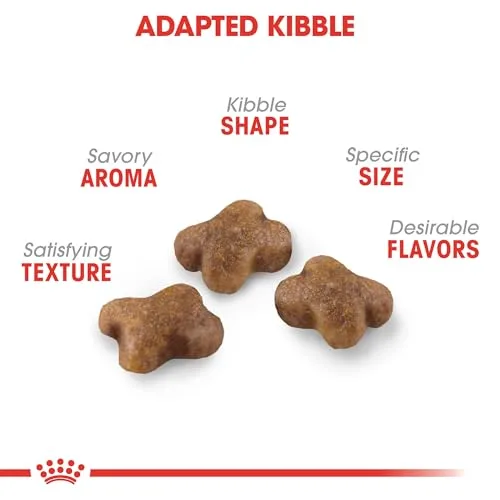
Royal Canin is famous for specific kibble shapes, and they nailed it here. The pieces are tiny—roughly the size of a small pea or a lentil. I watched my smallest runt, who usually struggles with standard kibble, crunch these without dropping them. The texture seems slightly more porous than generic brands, which makes it easier for baby teeth to break down.
The Ingredient Composition
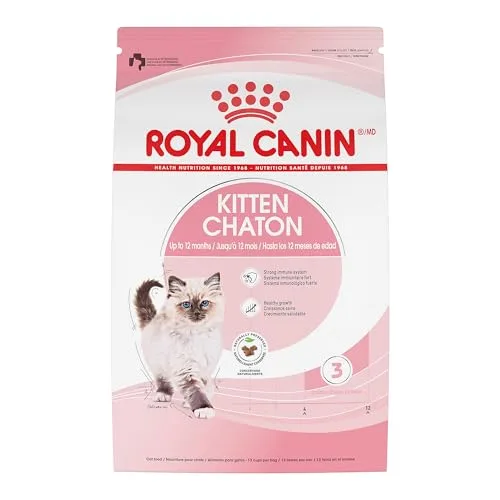
This is where I get conflicted. The bag is durable and reseals well (a practical plus), but reading the label requires a reality check. The first ingredient is “Chicken by-product meal,” followed by brown rice and wheat gluten.
For the price point, you might expect whole deboned chicken or zero grains. However, the “design” here is about digestibility, not trendy ingredients. The specific fibers and prebiotics included are clearly engineered to stop stomach upset, even if the corn and wheat look cheap on paper.
⚙️ Real-World Performance
Specs on a bag don’t tell you how a cat lives with the food. Here is what I observed over a month of feeding.
The Palatability Factor
I have yet to meet a kitten that turns this down. It has a fairly strong, fatty aroma that seems to trigger an instant eating response. Even a kitten recovering from a URI (upper respiratory infection), who couldn’t smell very well, showed interest in this bowl over a wet food alternative I offered.
Energy and Growth
Kittens burn calories at a ridiculous rate. I noticed sustained energy levels throughout the day. Usually, with lower-quality fillers, you see a sugar-crash style nap immediately after eating. With this, the kittens stayed active and playful for longer stretches post-meal. Their coats also transformed from slightly coarse to a very sleek, shiny texture after about three weeks.
📉 The Downsides
It’s not all perfect. Here are the issues that annoyed me during testing:
- The Price Tag: This is expensive food. When you look at the ingredient list and see corn and wheat gluten, it stings a bit to pay premium prices. You are paying for the R&D and the consistency, not the raw cost of ingredients.
- Stool Smell: While the poop was solid (a huge plus), it was arguably stinkier than when I feed them raw or grain-free diets. The high protein and specific fibers seem to produce a very potent odor.
- Grain Heavy: If you are strictly looking for a “natural” or “ancestral” diet for your cat, this isn’t it. It relies heavily on agricultural crops (rice, corn, wheat) which some owners prefer to avoid entirely.
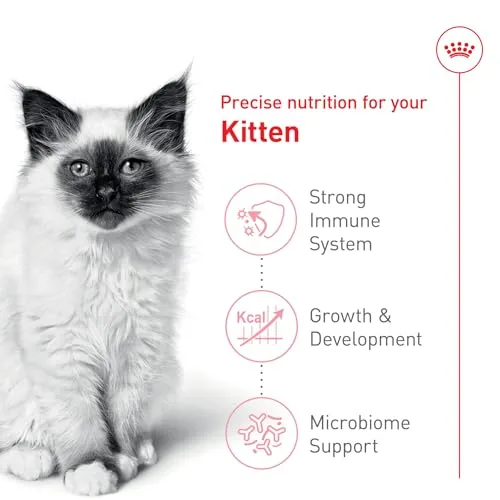
📊 Pros/Cons
| ✅ What I Liked | ❌ What I Didn’t |
|---|---|
| Incredibly consistent digestion (stops diarrhea). | Very expensive for a grain-inclusive food. |
| Tiny kibble size is perfect for 4-month-old mouths. | First ingredient is by-product meal, not fresh meat. |
| High calorie density supports active growth. | Stool odor can be quite strong. |
🥊 Head-to-Head: Royal Canin vs. Blue Buffalo Wilderness
The most common question I get is: “Should I buy this or Blue Buffalo?”
🆚 The Matchup:
- Blue Buffalo Wilderness Kitten: Focuses on “High Protein” and “Grain-Free.” The label looks prettier to humans because it lists real chicken first and no corn. However, in my experience, the richness often causes loose stools in sensitive kittens.
- Royal Canin Kitten: Focuses on digestive science. The label looks “worse” (corn/wheat), but the performance is remarkably better for sensitive stomachs.
My Take: If your kitten has a cast-iron stomach, Blue Buffalo is fine. But if you are dealing with any gas, soft stool, or pickiness, Royal Canin wins easily.
🎯 Expert Verdict
Royal Canin Feline Health Nutrition Kitten is a specialized tool. It is not the most “natural” food on the market, but it is arguably the most reliable.
Buy this if:
- You have a kitten with a sensitive stomach or recurring loose stool.
- You want a kibble that is extremely easy for young cats to chew.
- You prefer science-backed nutrition over “trend” ingredients.
Skip this if:
- You are on a tight budget (there are cheaper options like Purina One that are decent).
- You are strictly opposed to by-products or grains in your pet’s food.