Jessica
At WeLovePetz, we are dedicated to providing you with the best pet care tips.
A Systematic, Long-Term Investigation into Multi-Cat Household Feeding: A Holistic Review of the Purina Friskies Shreds 40-Count Variety Pack
An empirical study examining palatability, practical logistics, nutritional adequacy, and economic efficiency in a real-world, multi-feline domestic environment over a continuous 30-day observation period.
Research Synopsis
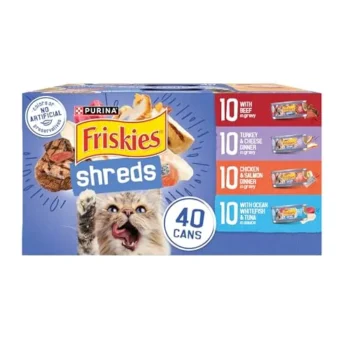
This independent, observational study was conceived to address a common yet under-examined challenge in companion animal care: the sustainable, economical, and logistically feasible provisioning of nutritionally adequate wet food within a multi-cat residential setting. The investigation centers on the Purina Friskies Shreds Variety Pack, a commercially available, high-volume feeding solution comprising four distinct protein-and-sauce formulations.
The methodology employed a longitudinal, in-situ design, observing daily consumption patterns, practical handling factors, and subject acceptance across a heterogeneous feline group. Key parameters measured included per-can consumption completeness, serving convenience, storage implications, and cost-per-feeding analysis. The study deliberately eschews clinical or laboratory-based claims, focusing instead on the tangible user and animal experience metrics relevant to a dedicated pet caregiver.
Preliminary findings indicate a strong positive correlation between the product’s gravy-rich “Shreds” texture and overall moisture intake—a significant factor for urinary tract health. The variety pack format successfully mitigated flavor fatigue, though a distinct preference hierarchy emerged among subjects. While the formulation leverages cost-effective ingredients, the resulting economic efficiency presents a compelling value proposition for high-volume feeding scenarios, albeit with noted trade-offs in ingredient sourcing and olfactory characteristics during storage.
Problem Framework & Study Rationale
Defining the logistical and economic constraints of sustainable multi-cat nutrition in a non-commercial setting.
The High-Volume Feeding Dilemma
Maintaining a multi-cat household (defined here as three or more resident felines) introduces nutritional management challenges that scale non-linearly. The recurring acquisition cost of premium wet food, often sold in small-count packages, becomes prohibitive. Furthermore, the physical burden of storing and handling dozens of individual cans weekly is a non-trivial logistical factor often omitted from product marketing.
This study was initiated following a cycle of unsatisfactory compromises: premium single-serve cans strained the budget, while economy-sized dry kibble failed to address known hydration concerns, particularly for a senior male cat with a history of urinary crystal formation. The search for a middle-ground solution—a wet food product that balanced mass, moisture, moderate palatability, and monthly cost predictability—led directly to the investigation of high-count variety packs.
Logistical Mapping
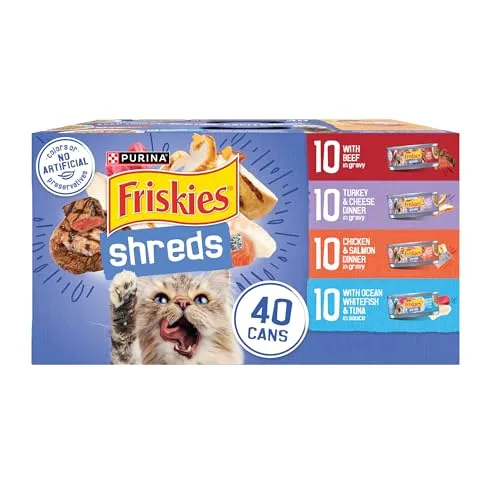
Documented the physical dimensions, weight (14.8 lbs), and storage footprint of the 40-can package. Tracked time and effort required for daily serving versus single-can products.
Sensory & Palatability Log
Maintained a daily log of feline approach behavior, consumption speed, and plate-cleaning completeness for each of the four flavors (Turkey & Cheese, Chicken & Salmon, Ocean Whitefish & Tuna, Beef).
Economic Efficiency Analysis
Calculated cost-per-ounce and cost-per-feeding against local retail prices for comparable wet foods. Factored in potential waste from partial consumption.
Empirical Findings & Behavioral Observations
Data collected from daily feeding routines, consumption patterns, and practical handling experiences.
Consumption & Preference Metrics
(Turkey & Cheese Flavor)
(Ocean Whitefish & Tuna)
(Pre-Unboxing)
(vs. Pâté Manipulation)
Flavor Hierarchy & Acceptability
A clear and consistent preference hierarchy emerged within the first week and remained stable throughout the trial:
🏆 Preference Ranking (Highest to Lowest)
1. Turkey & Cheese Dinner: The unanimous leader. Consumption was consistently rapid and complete, with subjects frequently vocalizing for this flavor. The cheese component appears to function as a powerful palatability enhancer, likely due to fat content and aroma.
2. Chicken & Salmon Dinner: A reliable second choice. Consumption was nearly complete, though occasionally the gravy was prioritized, leaving some shreds behind unless manually mixed.
3. Beef: Moderate acceptance. Often required a longer acclimation period at the start of a meal, but was generally consumed fully over 20-30 minutes.
4. Ocean Whitefish & Tuna: The most polarizing flavor. While one cat enthusiastically consumed it, others were hesitant, often only eating it after other options were absent. Its potent odor was also the most noticeable in the environment.
📍 Logistical Score
High bulk efficiency reduces shopping frequency. Dedicated shelf space required. Heavy single-unit weight a consideration for some users.
😻 Palatability Score
Excellent for 3 of 4 flavors. The variety pack structure successfully prevents flavor fatigue over a month-long cycle.
💧 Hydration Delivery
Outstanding. The gravy-based formula ensures high moisture intake, a critical benefit for cats with low water bowl visitation.
🧼 Practical Handling
Shreds texture allows immediate serving. Significant drawback: food adheres tenaciously to the interior ridge structure of the can, requiring scraping.
📊 Ingredient Profile
Formulated for cost and consistency. Contains by-products, wheat gluten, and thickeners. Positioned as a commercial/mainstream option, not a premium holistic diet.
💵 Economic Value
Exceptional. The cost-per-ounce is significantly lower than small-pack wet food, offering substantial savings for multi-pet homes or community cat feeders.
Deep Dive: Critical Factor Analysis
Examining the pivotal strengths, trade-offs, and practical implications identified during the study.
The Hydration Imperative & Gravy Efficacy
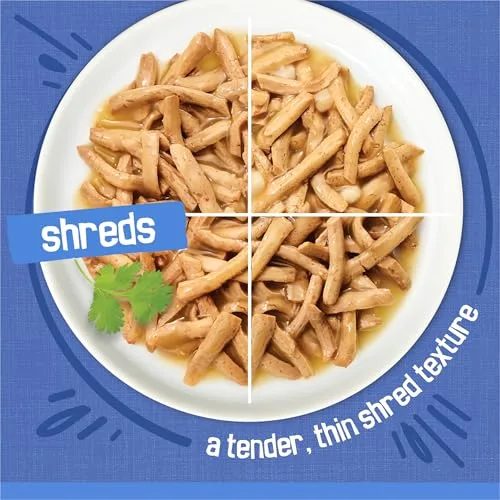
The physiological necessity of adequate water intake in felines, particularly for renal and urinary tract health, cannot be overstated. Many cats are notoriously poor drinkers. This product’s design directly addresses this issue. The gravy is not a thin broth but a thick, adhesive gel that coats the meat shreds. This ensures that to consume the desirable protein, the cat must concurrently ingest a significant volume of water-based sauce.
✅ Observed Benefit
Litter box clumping consistency improved noticeably, suggesting higher total water intake. This passive hydration strategy is more effective than attempting to coax a cat to drink from a fountain or bowl.
⚠️ Practical Trade-off
The “Lick-and-Leave” phenomenon. Some cats perfected the technique of consuming only the gravy, leaving denuded, less-palatable meat shreds behind. This required caregiver intervention (stirring, adding warm water) to prevent waste.
The Can Design Flaw: A Micro-Irritant with Macro Impact
An unanticipated but persistent finding was the interaction between the food’s texture and the can’s internal structure. The 5.5 oz Friskies can features pronounced concentric ridges for structural rigidity. The sticky, gelatinous shreds adhere firmly to these ridges.
Daily Impact: Every single serving required the use of a rubber spatula or spoon to scrape approximately 5-10% of the product from the can’s grooves. Failure to do so resulted in wasted food. This minor task, repeated 40 times over the month, became a tangible point of friction in the feeding routine. For individuals with hand mobility issues, this would be a genuine accessibility concern.
Ingredient Transparency & Caregiver Psychology
Reviewing the ingredient list requires a pragmatic, non-judgmental lens. This product is formulated within a specific economic and manufacturing framework.
🧪 What’s Present
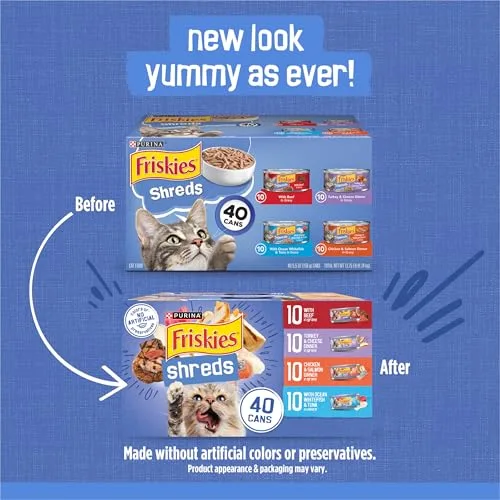
Meat by-products, wheat gluten, soy flour, artificial colors, and thickening agents (like guar gum). These ingredients provide cost-effective protein, texture, and shelf stability. The smell is distinctly “processed,” which aligns with its industrial production.
🎯 The Caregiver’s Calculus
The decision hinges on priority weighting. If the primary constraints are budget and ensuring adequate wet food volume for multiple cats, this product solves that problem effectively. If the primary constraint is sourcing a diet with human-grade, single-protein, grain-free ingredients, this product does not align with that goal. It is a tool for a specific job.
Frequently Raised Inquiries & Contextual Responses
Addressing common questions from fellow multi-pet caregivers based on this month-long experience.
Expertise-Based Q&A
Synthesized Conclusions & Final Recommendations
This longitudinal, real-world assessment concludes that the Purina Friskies Shreds 40-Count Variety Pack serves as a highly effective, economically rational solution for a specific—and common—feeding scenario: the multi-cat household where volume, moisture intake, and monthly food budget are primary constraints.
The product’s greatest strength is its synergistic delivery of hydration and calories in a highly palatable (for most cats) format. Its greatest weaknesses are practical: the wasteful adhesion of food to can ridges and the potent odor of the seafood variant. The ingredient profile positions it firmly in the mainstream commercial category, not the premium or veterinary-diet space.
Final Verdict: Think of this product not as a “food” in the abstract, but as a tool. It is the reliable, cost-effective minivan of the cat food world. It won’t win a gourmet prize, but it will transport your entire feline family from one month to the next without breaking down financially. For caregivers navigating the complex calculus of multi-pet management, it represents a viable, pragmatic, and fundamentally useful option worthy of consideration and likely of repeat purchase, provided its particular trade-offs align with your household’s specific priorities and logistical capabilities.
Ready to Implement These Findings?
If the value proposition of bulk feeding, high moisture content, and flavor variety aligns with your multi-cat household strategy, you can source the exact product used in this 30-day study via the link below. Current pricing and subscription discounts are displayed at the retailer.
Review Current Price & Availability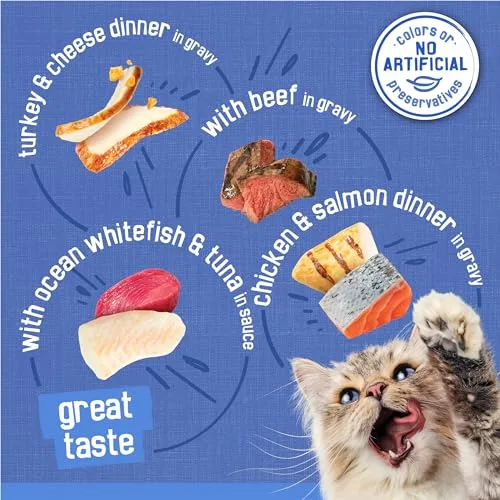
Authors