Jessica
Welcome to WeLovePetz, your number one source for all things pets.
If you have a large dog—say, over 60 pounds—you are likely familiar with the “hammock slump.” Standard fabric dog hammocks are great for keeping hair off the seats, but they offer zero structural support. When you brake, the fabric sags into the footwell, and your dog stumbles or slides forward. It is uncomfortable for the dog and distracting for the driver.
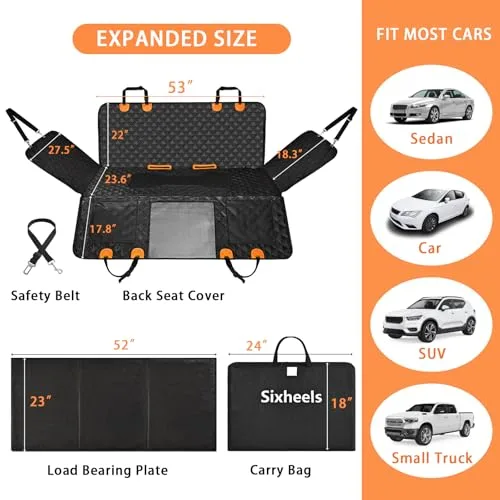
The solution is a “seat extender” or “bridge”—a hard-bottomed platform that turns your back seat into a flat, solid bed. Today, I am reviewing this Hard Bottom Backseat Extender and Protector. It claims to support up to 420 pounds using reinforced PP boards. But does it actually fit most vehicles, and is the upgraded PU leather surface durable enough for sharp claws? Let’s break it down.
Key Features and Design Analysis
This product distinguishes itself from the sea of cheap polyester covers with its internal structure. Here is what you are actually paying for:
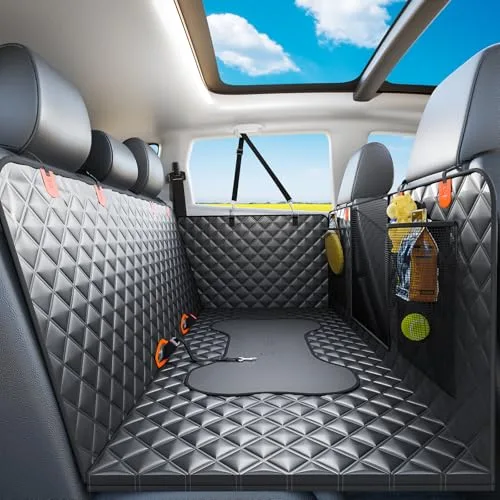
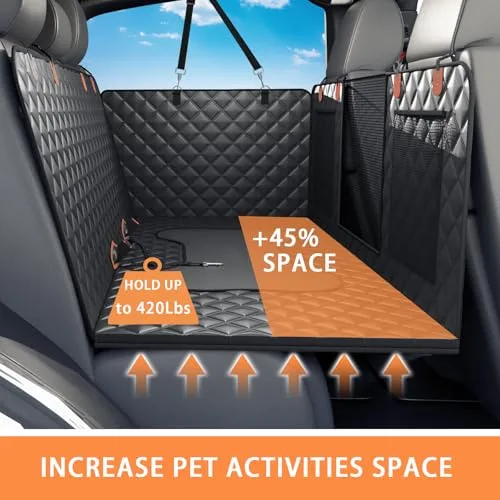
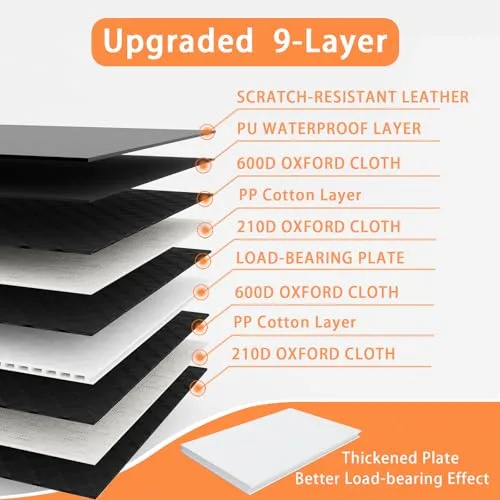
- Hard Bottom Construction: The core feature is the thickened PP (Polypropylene) board inside the cover. Unlike soft hammocks that rely on tension, this creates a rigid bridge over the footwell. This effectively doubles the surface area your dog has to lay on.
- 420lb Weight Capacity: The manufacturer claims a massive load-bearing capacity. While this likely refers to distributed weight rather than a single point, it suggests it can easily handle a Great Dane or two Golden Retrievers without collapsing.
- PU Leather Surface: Instead of the standard Oxford cloth, this model features bone-shaped PU leather patches. This is marketed as being easier to clean and more resistant to fluids, acting almost like a waterproof tarp.
- Mesh Visual Window: A central mesh panel allows air from the A/C to reach the back seat and lets the dog see you, which can reduce anxiety in nervous travelers.
- Storage and Portability: The unit is foldable and comes with a storage bag. It also includes side pockets for leashes or treats.
Hands-On Performance: Does It hold Up?
I evaluated this extender based on stability, fit, and material quality. Here is the reality of using a hard-bottom extender.
Stability and The “Bridge” Effect
The immediate difference between this and a soft hammock is the stability. When a large dog steps off the seat and onto the area over the footwell, a soft hammock sinks. This hard bottom unit does not. It feels much like a crate floor.
For older dogs with arthritis or joint issues, this is a game-changer. They don’t have to balance on uneven surfaces. However, because the bottom is rigid, it is essentially a hard board. You must add a blanket or a dog bed on top for comfort. The PU leather alone provides zero cushioning.
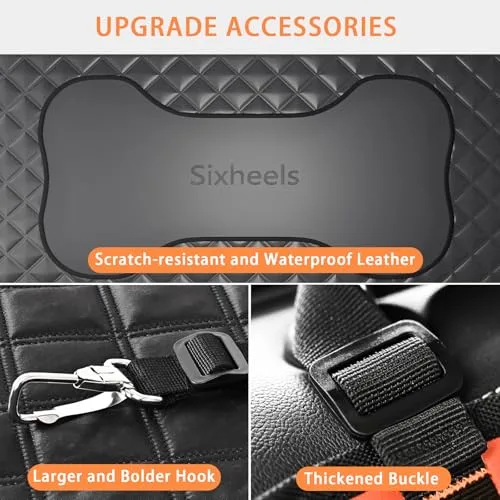
Material Quality: PU Leather vs. Claws
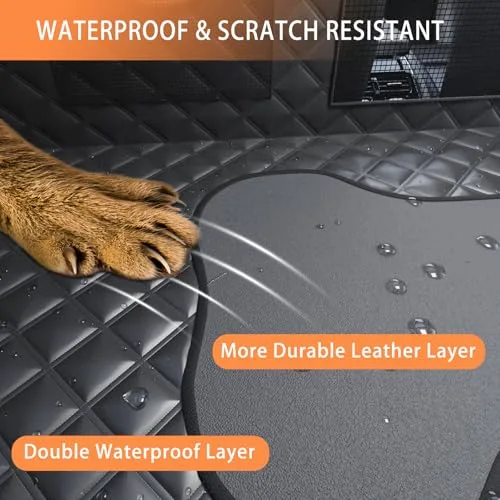
The “upgraded” PU leather is a double-edged sword. On the positive side, it is incredibly easy to clean. Muddy paw prints wipe off instantly with a damp cloth, unlike fabric covers that trap grit in the weave. It is also genuinely waterproof.
The downside? It can be slippery. If you take a corner sharply, a dog standing on PU leather will slide. Again, this necessitates throwing a blanket down for traction. Furthermore, while the leather is thick, extremely sharp claws might puncture it over time, whereas ballistic nylon tends to be more puncture-resistant.
Fitment in SUVs vs Trucks
The extender works by resting on the back seat and hanging from the front headrests. In most mid-sized SUVs (like a CR-V or RAV4), the fit is near perfect. However, in full-sized trucks (F-150, Silverado), the gap between the front and back seats is huge. While the straps are adjustable, the rigid board might not fully cover the massive footwell gap in a Crew Cab truck, leaving a slight dip. Measure your footwell gap before buying.
Pros & Cons
| ✅ The Good | ❌ The Bad |
|---|---|
| True Space Maximizer: Utilizing the footwell space gives dogs ~30% more room to stretch out. | Slippery Surface: The PU leather offers little traction compared to textured fabric. |
| No Sagging: Supports heavy dogs without them sinking into the floor gap. | Storage Bulk: Unlike soft covers, you can’t just wad this up; the hard boards take up trunk space. |
| Easy Cleaning: Hair doesn’t weave into the leather; liquids wipe right off. | Hard Surface: Requires additional bedding for long-trip comfort. |
| High Airflow: The mesh window prevents the back seat from becoming a hotbox. |
Comparison: Extender vs. Hammock
Is the extra cost of a hard-bottom extender worth it compared to a standard hammock?
| Feature | Hard Bottom Extender (This Product) | Standard Soft Hammock | Back Seat Mattress (Inflatable) |
|---|---|---|---|
| Stability ⚖️ | High (Rigid Board) | Low (Fabric Tension) | Medium (Air Support) |
| Weight Limit 🏋️ | ~400 lbs | N/A (Sags) | ~300 lbs |
| Durability 🛡️ | High (PU Leather) | Medium (Quilted Nylon) | Low (Puncture Risk) |
| Setup Time ⏱️ | 2 Minutes | 1 Minute | 10 Minutes (Inflating) |
Verdict
The Hard Bottom Rear Seat Extender solves a specific problem effectively: it creates a safe, stable platform for large dogs who otherwise struggle with balance in a moving car. If you have a Greyound, German Shepherd, or heavy Mastiff, the structural support this provides is vastly superior to a standard fabric hammock.
However, the “luxury” PU leather finish, while easy to clean, requires you to add a non-slip mat or blanket to prevent your dog from sliding around. It is a tool for stability, not necessarily immediate comfort.
Recommendation: Highly recommended for owners of dogs over 50lbs or multiple dogs who need more square footage. If you have a small dog that stays in a booster seat, this is overkill.