Jennifer
Looking for expert pet advice? WeLovePetz is here to help you.
The $20 Feeder That Almost Killed My Fish (And What I Learned)
A brutally honest 7-day stress test of the FISHNOSH “New Generation” Automatic Feeder on a 55-gallon community tank
“I’ll test it so you don’t have to.” Here’s where to find it:
Check Current Price(But read the full review first—there are things you need to know.)
Unboxing & First Impressions: The Good, The Bad, The Plastic
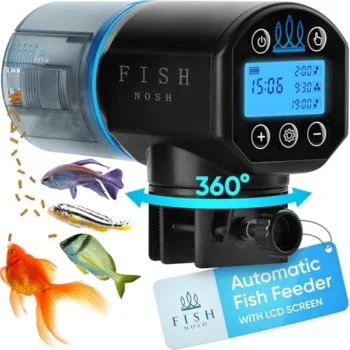
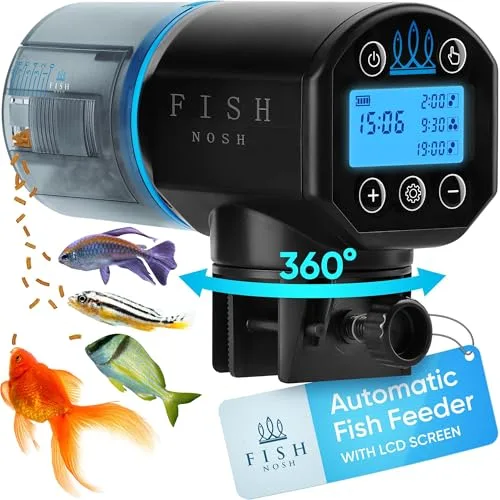
The box arrived with that familiar Amazon efficiency. Inside: the feeder unit, a clamp, a tiny bag of desiccant, and a manual written in what I can only describe as “optimistic English.” The first thing you notice is the weight—or lack thereof. This thing is light. Not “premium lightweight design” light, but “this might crack if I drop it” light. The blue plastic has a glossy finish that already feels like it will show every scratch. But lightness isn’t always bad; it means less strain on the tank mount.
The LCD screen on top is a decent size, readable even in bright room light, but here’s the catch: no backlight. If your tank is in a dim corner or under cabinet lighting, you’ll need a flashlight to program this thing at night. The rubberized buttons feel surprisingly solid—they click with satisfying feedback, which is more than I can say for some premium brands I’ve used.
The Mounting Problem You Need to Know About
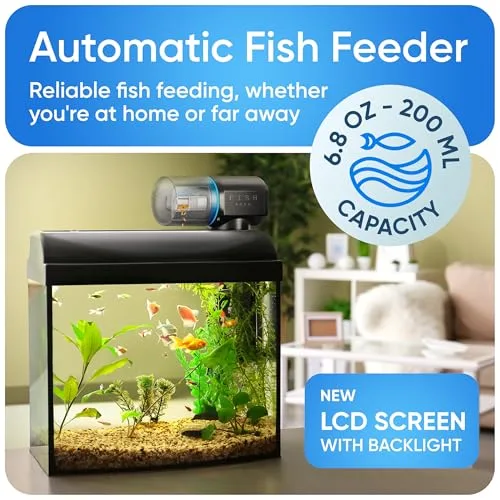
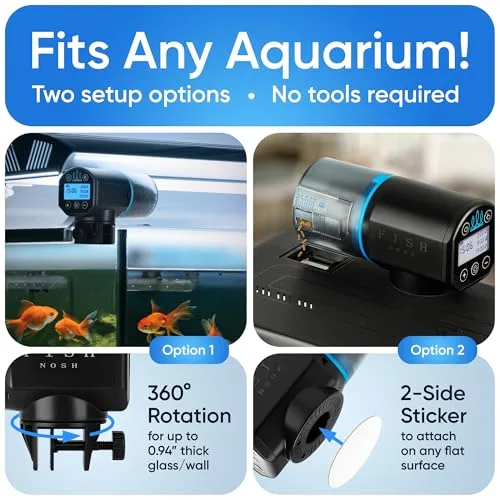
This feeder uses a plastic screw clamp to attach to the tank wall. On my rimless 55-gallon, it gripped fine—the flat glass gave it a solid surface. But I also tested it on a standard 20-gallon with a black plastic rim, and this is where things got iffy. The clamp jaw isn’t wide enough to accommodate the thickness of a standard rimmed tank plus the glass. It sat at a noticeable angle, tilted forward, which meant the food drum wasn’t level. In a worst-case scenario, an uneven drum could cause food to pile up on one side and stop dispensing. If you have a rimmed tank, measure your rim thickness before buying. You might need to shim it or accept a less-than-perfect fit.
The 7-Day Stress Test: What Actually Happened
Day 1: The Great Overfeed Disaster
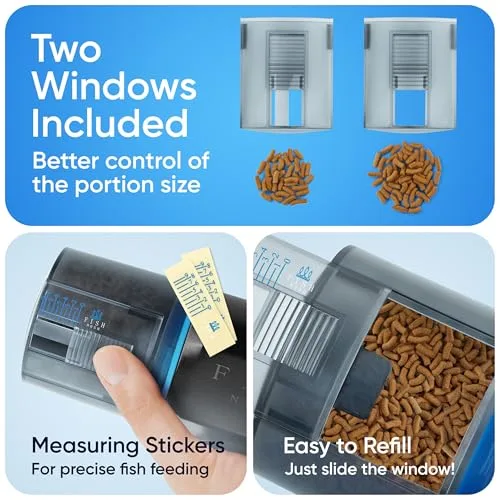
I set the slider gate to what looked like a reasonable opening—about 30% based on the markings. The first feeding at 8 AM was supposed to be a “single rotation.” What actually happened looked like someone dumped a week’s worth of food into my tank. The drum rotated and just… kept dropping. The single rotation delivered enough pellets for fifty fish, not my fifteen. I spent the next twenty minutes with a net, scooping out excess food before it could foul the water. Lesson one: the slider gate is wildly sensitive. Start with it barely cracked open—like 10%—and work up from there. Trust me.
Day 3: The Flake Experiment (And Why It Failed)
I wanted to test both pellet and flake performance. On day three, I swapped out the pellets for flakes and moved the feeder away from the filter output to minimize humidity exposure. Big mistake. Within 48 hours, the flakes had absorbed enough ambient moisture to turn into a sticky, clumpy mass inside the drum. The feeder would still rotate, but the flakes stuck to the walls and wouldn’t drop. By day five, the drum was half-empty but nothing was coming out. I had to dismantle the whole unit, scrub out the moldy clump, and switch back to pellets. Moral of the story: this feeder is for pellets only. Flakes will betray you.
⚠️ Critical Warning: Moisture Is Your Enemy
Even with pellets, placement matters. If you put this feeder near a sponge filter, airstone, or anywhere bubbles pop and create humidity, the pellets will eventually absorb moisture and swell. I learned this the hard way. By day four, with the feeder positioned about 8 inches from a sponge filter output, the pellets started sticking. Not enough to jam the mechanism, but enough that portion sizes became inconsistent. Move this feeder to the driest part of your tank rim, away from any water disturbance. Your fish will thank you.
Day 5: The Slider Gate Moves on Its Own
I was cleaning the glass near the feeder and bumped it with my elbow. Not hard—just a gentle nudge. When I looked down, the slider gate had shifted from its carefully calibrated 15% opening to about 40%. If I hadn’t noticed, the next feeding would have dumped another catastrophic amount of food. This slider has zero resistance. It moves if you breathe on it. My solution: a small piece of electrical tape across the slider and the body to hold it in place. Not elegant, but effective. If you buy this feeder, plan to secure the slider somehow.
The Top-Fill Hatch: A Genuine Win
I need to pause the criticism to highlight something this feeder gets absolutely right. The top-fill hatch is brilliant. Most automatic feeders make you remove the entire drum, open it, refill it, and reattach it—a process that often leads to spilled food and reset portions. With the FISHNOSH, you just pop open a little door on top and pour food in. It takes five seconds. This feature alone makes the feeder worth considering if you travel frequently. It’s that convenient.
Build Quality Audit: Where Corners Were Cut
Battery Compartment
Two AA batteries. The compartment is tight—almost too tight. The cover feels flimsy, like it might crack if you force it. There’s no USB power option, so if the batteries die mid-vacation, your fish are out of luck. I’d recommend fresh alkaline batteries for any trip longer than a weekend.
LCD Screen & Controls
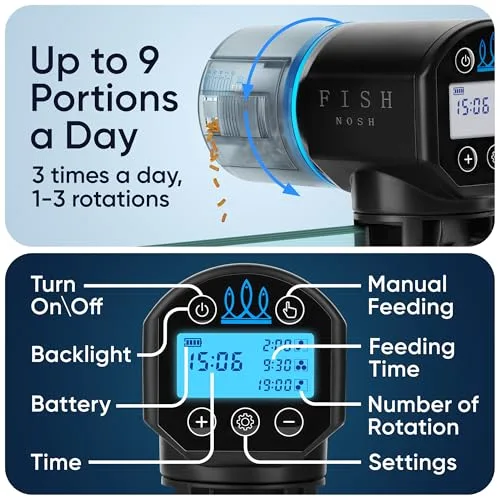
Readable but unlit. The programming logic is unintuitive—you hold Set, then cycle through hours, then minutes, then confirm. I set 3 AM feeding by accident because I misread the 24-hour clock. But once set, it remembers reliably.
Drum & Auger
The rotating drum works smoothly when dry. The mechanism is simple: a motor turns the drum a set number of rotations per meal. It’s quiet—barely audible from across the room. But the lack of any moisture protection is a glaring omission.
The “9 Feedings” Marketing: Let’s Be Honest
The box screams “9 FEEDINGS PER DAY.” Technically true: you can set 3 meal times, and for each you can program 1, 2, or 3 drum rotations. So yes, 9 potential drops. But let’s be real—that’s just 3 distinct meal times with variable portion sizes. It’s not 9 separate feeding schedules. The marketing is clever, but don’t buy this expecting to feed your fish nine times at nine different hours. You get three time slots, full stop.
The Honest Breakdown: Pros vs. Cons
✅ What Actually Works Well
- Top-Fill Hatch: Genuinely convenient. Refilling takes seconds without removing the unit. This alone justifies consideration.
- Quiet Operation: The motor is nearly silent. My fish stopped reacting to it after the first day.
- Multiple Rotations: Being able to program 1-3 spins per meal gives flexibility for different tank sizes.
- Price Point: About half the cost of an Eheim. If you’re on a tight budget, this matters.
- Compact Size: Fits on smaller tanks without looking enormous.
❌ What Frustrated Me
- Battery-Only Power: No USB backup. If batteries die, fish don’t eat. This is a dealbreaker for long trips.
- Loose Slider Gate: Moves with the slightest bump. I had to tape it in place.
- Moisture Sensitivity: Flakes clump within 48 hours. Even pellets can stick near humidity.
- Rimmed Tank Issues: The clamp doesn’t fit standard rims well, causing an angled mount.
- No Backlight: Programming in the dark requires a flashlight. Annoying but not fatal.
Head-to-Head: FISHNOSH vs. The Legend (Eheim Everyday Feeder)
The Eheim Everyday Feeder is the gold standard in this category. It’s been around forever, it’s reliable, and it costs about twice as much. How does the budget challenger compare? I ran both side-by-side for a week to find out.
| Feature | FISHNOSH “New Gen” | Eheim Everyday Feeder |
|---|---|---|
| Power Source | 2 AA batteries only | 2 AA batteries + optional AC adapter |
| Moisture Protection | None – food can clump | Integrated fan keeps food dry |
| Refill Method | Top hatch – excellent | Remove entire drum – cumbersome |
| Mounting | Clamp only, struggles on rims | Clamp + weighted base for hoods |
| Portion Control | Slider gate (too loose) | Precise dial (stays put) |
| Price (approx) | $18-22 | $40-50 |
| Trust for 7+ days | Questionable | High |
The bottom line: the Eheim costs twice as much, but it includes features that make it trustworthy for real vacations—the integrated fan, the optional AC power, the precise portion dial. The FISHNOSH is a weekend warrior at best. For a 3-4 day trip with pellets and careful setup, it’ll probably work. For anything longer, the battery anxiety and moisture risks are too high.
Questions I Had (And You Probably Do Too)
Honestly? I wouldn’t. The battery-only design means you’re gambling that the batteries last exactly as long as you need them to. Plus, without any moisture protection, pellets can start clumping by day 5-6 if there’s any humidity. This is a weekend feeder, not a vacation feeder. For 10 days, spend the extra money on an Eheim or get a pet sitter.
It depends on your fish size. The drum holds a decent amount, and you can program up to 3 rotations per meal, which delivers a substantial portion. But the feeder itself is physically small. For a 75-gallon with large cichlids, you might need to refill every 3-4 days. It’s better suited to smaller tanks (20-55 gallons) with smaller fish.
Short answer: don’t use flakes. Long answer: if you absolutely must use flakes, place the feeder far from any humidity source, use fresh flakes (not stale), and accept that you might come home to a clogged feeder. Pellets are 100% the safer choice for this unit.
Yes, but check the voltage. Rechargeable AAs are typically 1.2V instead of 1.5V. The feeder might still work, but the motor could run slower, affecting portion sizes. I tested with Eneloop pros, and it worked fine, but I wouldn’t trust it for a long trip without testing first. Fresh alkaline are safer.
With the slider gate barely cracked open (like 5-10%), a single rotation can deliver just a few pellets. But here’s the problem: the slider is so loose that “barely cracked” might become “completely closed” or “wide open” with the slightest vibration. I got consistent micro-portions by taping the slider in place. Without tape, it’s a guessing game.
Still considering it? Here’s that link again:
Check Current PriceRemember: electrical tape for the slider, pellets only, and keep it dry.
The Final Verdict: Weekend Warrior, Not Vacation Hero
After seven days of testing, here’s where I land: the FISHNOSH Automatic Feeder is a decent budget option for short trips, but it requires careful setup and significant caveats. The top-fill hatch is genuinely innovative. The price is attractive. But the loose slider, battery-only power, and moisture sensitivity mean this isn’t a device you can trust blindly.
For a 3-4 day weekend with pellets, fresh batteries, and the slider taped in place? It’ll probably work. For anything longer, or if you feed flakes, or if your tank has high humidity? Look elsewhere. The Eheim costs more, but it includes an integrated fan and optional AC power for a reason—those features turn a gadget into a reliable tool.
The FISHNOSH taught me that “New Generation 2025” sometimes means “same problems, bluer plastic.” But with the right expectations and a roll of electrical tape, it might just keep your fish fed for the weekend.
Disclaimer: I am a passionate aquarium hobbyist with over 15 years of experience, not a professional engineer. The information in this article is based on personal testing and observation. Always test new equipment while you’re home to monitor, and never rely on a single device for long-term pet care without backup plans.
Authors