
 Jennifer
Welcome to WeLovePetz, your number one source for all things pets.
An In-Depth Behavioral & Practical Analysis of Fancy Feast Savory Centers
Evaluating the “Gravy Core” Innovation as a Practical Solution for Fussy Feline Eaters, Senior Cats, and Budget-Conscious Multi-Pet Homes Over a 28-Day Feeding Trial
The Universal Feline Feeding Dilemma
If you share your life with cats, you’ve undoubtedly performed the same disappointing ritual. You select a can of premium wet food, hoping today will be different. You plate it with care. Your cat trots over, full of promise. They lean in, take a few eager laps at the surface gravy or jelly, and then… they stop. They sit back, perfectly content, leaving behind a monolithic, slowly drying lump of protein that you’ll inevitably scrape into the trash an hour later. It’s more than waste; it’s a daily exercise in nutritional frustration and financial regret. You’re paying for meat, but you’re only selling gravy.
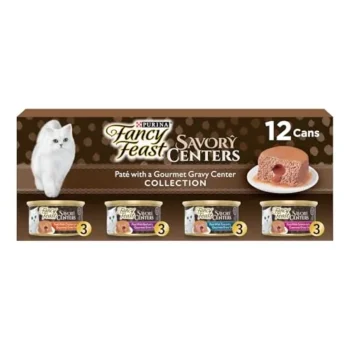
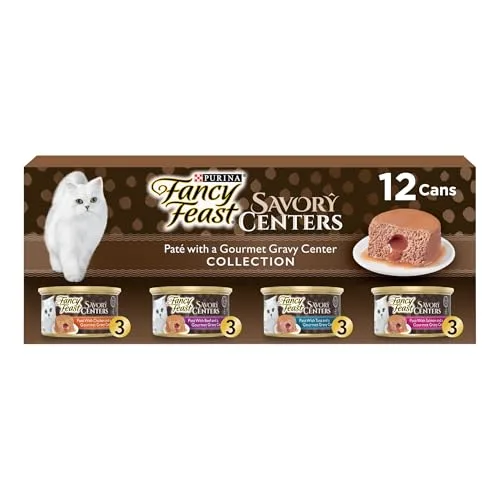
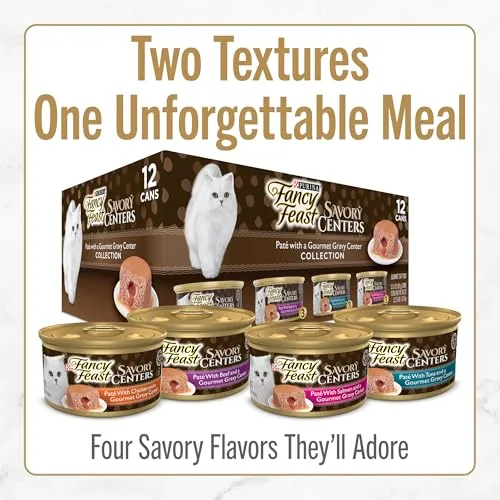
This specific dynamic—the “Gravy Licker vs. The Leftover Loaf”—is the precise problem Purina’s Fancy Feast “Savory Centers” line attempts to solve. The concept is deceptively simple, almost clever: instead of putting the enticing sauce on top where it can be skimmed off, hide it inside the pâté. To access the liquid gold, the cat must physically break through the meat barrier. It’s a culinary Trojan Horse. I purchased the 24-can variety pack (two packs of 12, featuring Chicken, Salmon, Beef, and Tuna) to conduct a month-long, real-world investigation. Is this engineered food delivery system a genuine breakthrough for picky eaters, or is it merely a messy marketing gimmick that creates more problems than it solves?
(Opens in a new window. As an Amazon Associate I earn from qualifying purchases.)
Executive Summary & Target Audience
Primary Use Case & Recommendation
After four weeks of twice-daily feedings to a panel of three cats with distinct eating personalities (The Dainty Licker, The Enthusiastic Glutton, and The Senior Nibbler), I can confidently define who will benefit most from this product.
- The Ideal User: The cat who consistently leaves dry pâté or chunks behind after consuming all surface moisture. This product architecturally prevents that behavior.
- The Secondary Beneficiary: Older cats or those with dental sensitivity who find standard loaf textures too dense or rubbery. The “Savory Centers” outer mousse is notably softer.
- The Budget-Minded Caregiver: Someone seeking a perceived “gourmet” or innovative texture at a mainstream price point, significantly below boutique or veterinary diet brands.
- Not Recommended For: Caregivers strictly seeking grain-free, by-product-free, or “clean label” formulas. This is a mass-market product with corresponding ingredients.
Deconstructing the Innovation: The Gravy Core Mechanism
The Trojan Horse Theory in Practice
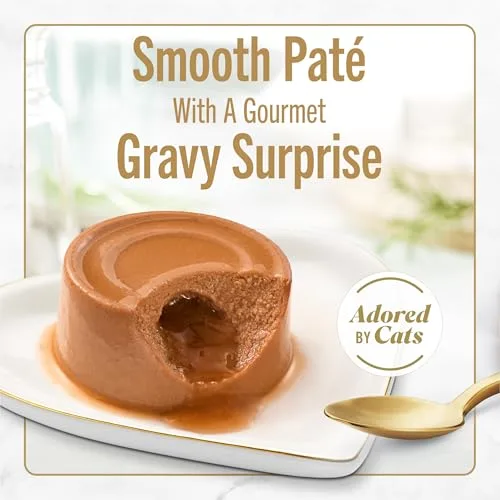
Upon first opening a can, the product appears as a standard, smooth-topped pâté. The magic—and the potential mess—is concealed. Using a fork to break the surface reveals a pocket of viscous, aromatic gravy sequestered in the center. This isn’t a uniform mixture; it’s a deliberate two-phase system. From a behavioral psychology standpoint, it’s brilliant. The cat’s initial investigation (licking the top) yields little reward, prompting a more invasive action: biting or digging. This action ruptures the gravy pocket, flooding the surrounding meat with flavor and moisture, effectively “saucing” each bite from within as the cat eats.
In my trial, this worked exactly as intended with my problem “licker.” His usual routine of superficial grazing was thwarted. His frustration at not finding immediate gravy led him to press his nose into the food, breaking the seal. The subsequent release of scent and flavor triggered a more committed eating behavior. He consumed over 95% of the serving, a drastic improvement from the 40-60% he often left of traditional pâté.
(vs. ~65% with standard pâté)
(Time for cat to access gravy)
(Ideal single meal portion)
(Chicken, Beef, Tuna, Salmon)
Texture & Palatability Profile
The exterior pâté is distinctly different from Fancy Feast’s Classic Pâté line. It is less dense, more aerated, and has a mousse-like, almost whipped consistency. It requires no mashing or added water for senior cats. It fragments under minimal pressure, making it excellent for cats with dental issues. The gravy core itself is a thick, savory broth—not watery. The flavor across all four varieties is potent and salty (in a way cats find appealing), with the seafood options (Tuna, Salmon) carrying the strongest, most pungent aroma.
Comprehensive Performance Breakdown
Relative Performance Metrics
1. Palatability & Consumption Speed: Excellent
The proof is in the empty bowl. This food is consumed quickly and completely. The integrated moisture ensures the last bite is as appealing as the first, preventing the typical mid-meal abandonment when the gravy is gone. The variety pack format successfully staved off flavor fatigue over the month.
2. Ingredient Quality & Nutrition: Moderate
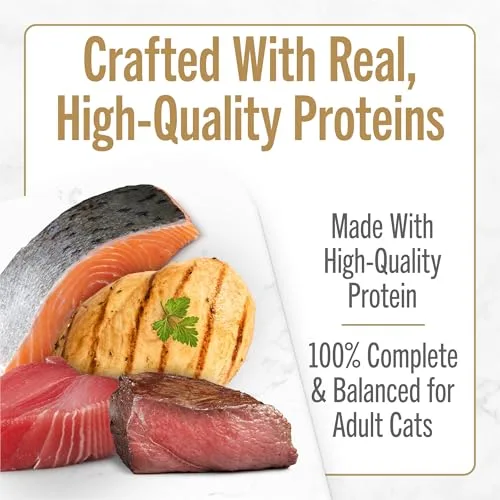
This is the trade-off. Fancy Feast operates in the mainstream commercial tier. The ingredient list includes “meat by-products,” “wheat gluten,” “soy flour,” and artificial flavors/colors. By-products are not inherently bad (they include nutrient-rich organs), but they are a deal-breaker for some. Wheat gluten is a protein source and binder. This is not a grain-free, limited-ingredient, or “human-grade” diet. It is calorically dense, tasty, and complete for adult maintenance, but it’s the fast food equivalent—engineered for craveability and consistency, not culinary purity.
3. Practical Usability & The “Splatter Factor”: Problematic
Here lies the product’s most significant practical flaw. The gravy core is under slight pressure. On at least five occasions during the trial, opening the pull-tab resulted in a small, surprising jet of gravy escaping from the seam, sometimes landing on the counter, the cupboard, or my hand. I learned to open cans over the sink, pointed away from me.
Furthermore, plating the food intact is a skill. Dumping the can typically leaves the gravy pocket stuck to the bottom. To present it as designed (gravy center up), you must gently scoop it out with a spoon, which can break the pâté. In roughly 1 in 5 cans, the gravy had migrated during transit, creating a lopsided core or simply a uniformly moist pâté. The cats didn’t mind, but the advertised “center” wasn’t always centered.
Comparative Analysis: Savory Centers vs. The Field
To understand its niche, we must compare it to its closest siblings within the Fancy Feast family and common alternatives.
| Feature | Savory Centers | Classic Pâté | Gravy Lovers / Florentine |
|---|---|---|---|
| Primary Texture | Ultra-soft mousse exterior with a sealed liquid gravy center. | Dense, uniform, firm loaf. Can be dry at edges. | Small meat chunks or shreds suspended in a copious, thin gravy. |
| Mess & Serving Difficulty | MODERATE-HIGH. Splatter risk on opening. Gravy core can be messy to plate neatly. | LOW. Plops out cleanly. No surprises. | MODERATE. Liquid can slosh/spill. Bowl is very wet afterward. |
| Protein-to-Sauce Ratio | High protein, with sauce integrated to enhance meat consumption. | Highest meat density. Minimal added moisture. | Lower meat density. High liquid content for hydration. |
| Best Suited For | The Strategic Feeder: Cats who lick gravy off pâté. Senior cats needing soft, moist food. Picky eaters who need engagement. | The Volume Eater: Cats who reliably eat all textures. Caregivers prioritizing meat content and clean serving. | The Hydration Focus: Cats who love to lap broth. Cats needing extra dietary moisture. True “gravy addicts.” |
| Biggest Drawback | Messy serving experience; contains wheat gluten/by-products. | Can be too dry for some cats, leading to abandonment. | Cats may drink gravy and leave chunks; high carbohydrate content from thickeners. |
In-Depth User FAQ: Addressing Real Concerns
No, it is not. The ingredient list explicitly includes “wheat gluten,” which is derived from grain. Wheat gluten serves as a binding agent to help create the distinct textured pâté and stabilize the gravy core. If your cat has a diagnosed wheat or grain allergy, sensitivity, or you adhere strictly to a grain-free diet philosophy, this product is not compatible with that requirement. Many cats tolerate it without issue, but it is a crucial consideration for informed purchasing.
Caloric content varies slightly by protein source. Based on the manufacturer’s information and my cross-referencing:
- Chicken & Beef Varieties: Approximately 70-75 calories per can.
- Tuna & Salmon Varieties: Approximately 65-70 calories per can.
This is standard for a 3oz wet food serving and is sufficient for a meal for an average-sized adult cat, often paired with dry kibble or another wet meal later in the day. Always adjust portions based on your cat’s individual weight, activity level, and your veterinarian’s guidance.
This specific “Savory Centers” product is labeled for “Adult Maintenance.” It is not formulated to meet the heightened nutritional demands of growth, reproduction, or lactation. Kittens require more protein, specific amino acids like taurine at higher levels, and more calories per pound than adults. While a taste likely wouldn’t harm them, their primary diet should be a high-quality food specifically labeled for “Kittens” or “All Life Stages.” Consult your vet for kitten nutrition advice.
Generally, no. The defining characteristic of Savory Centers is its extremely soft, mousse-like texture. It falls apart with minimal pressure from a cat’s tongue or teeth. For most cats, including many seniors, it is “ready-to-eat” as is. Adding water would dilute the gravy core and potentially make the exterior too soggy, undermining the textural contrast. The only reason to mash it would be to manually integrate the gravy for a cat that is exceptionally lazy, but that defeats the product’s behavioral design.
The odor is potent upon opening, which is partly why it’s so appealing to cats. The seafood flavors (Tuna, Salmon) are the strongest and most likely to permeate a kitchen quickly. The poultry and beef flavors are milder but still distinctly “canned cat food” in smell. To manage odor, I recommend rinsing empty cans immediately before recycling and washing the food bowl soon after mealtime. Using a stainless steel or ceramic bowl (rather than plastic) also helps reduce odor retention.
I am not a veterinarian and this is not medical advice. For cats with diagnosed chronic kidney disease (CKD), managing dietary phosphorus is often a critical component of care. Mainstream commercial foods like Fancy Feast are typically not formulated to be low in phosphorus. If your cat has kidney issues, you must consult with your veterinarian to select a diet that is specifically designed to support renal health, which may be a veterinary therapeutic diet. Do not make dietary changes for a medically compromised cat without professional guidance.
Final Verdict & Practical Recommendation
The Fancy Feast Savory Centers Variety Pack is a clever, effective, and largely successful solution to a narrow but pervasive problem. It accomplishes exactly what it sets out to do: it tricks gravy-obsessed cats into consuming the substantive protein portion of their meal by making the reward contingent on engagement. The softer texture is a boon for senior cats and those with dental challenges.
However, this innovation comes with tangible compromises. The serving process can be messy and unpredictable. The ingredient profile will not satisfy caregivers seeking a “premium” or “natural” formula. It is, fundamentally, a well-executed commercial pet food using cost-effective ingredients in a novel structural format.
Who should buy it? If your primary pain point is food waste from a picky “licker,” and your cat has no known grain sensitivities, this product is likely worth its weight in gold. It will save you money, frustration, and ensure better nutrition. View it as a functional tool rather than a health food.
Who should avoid it? If you prioritize a minimalist ingredient list, require a grain-free diet, or simply cannot abide a potentially messy feeding routine, look to other solutions like adding a low-sodium broth to a higher-quality pâté or exploring different protein formats.
In my household, the “Savory Centers” have earned a permanent spot in the rotation. They solved a specific behavioral eating problem that no amount of cajoling or ingredient upgrading had previously fixed. That, in the pragmatic world of multi-cat management, is a significant win.
(Link to Amazon for convenience and subscription discount options.)
Disclaimer: I am a passionate pet owner, not a veterinarian. The information in this article is based on research and personal experience. Always consult your vet before changing your pet’s diet or medication.