Jessica
Looking for expert pet advice? WeLovePetz is here to help you.
The ‘Truth’ Test: Does It Actually Work?
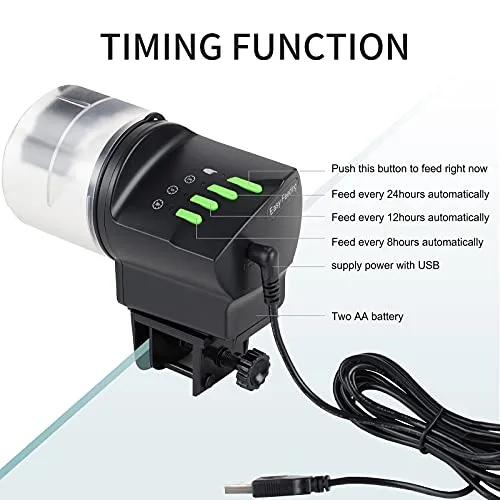
I didn’t bother reading the manual immediately. I wanted to see if I could set this up intuitively, which is usually the downfall of cheap aquarium electronics. I took the DXOPHIEX feeder out of the box, loaded it with medium-sized pellets, and plugged it into a USB block.
The immediate “hook” here is the dual power supply. Most feeders I’ve used over the years rely solely on AA batteries. If those die while you are on a two-week vacation, your fish starve. I tested this specific mechanism first. I put batteries in, plugged in the USB, and started the rotation cycle. Mid-cycle, I yanked the USB cord out. The feeder didn’t stutter. It seamlessly switched to battery power and finished the rotation. That alone gave me enough confidence to actually put it on my tank.
However, setting the time isn’t as precise as I would like. It doesn’t have a digital clock (e.g., “Feed at 8:00 AM”). Instead, it uses an interval system (8, 12, or 24 hours). This means if you want it to feed at 7:00 AM, you have to physically be there at 7:00 AM to press the button and start the cycle. It works, but it requires you to be present for the initial setup.
🏗️ Build & Design Audit
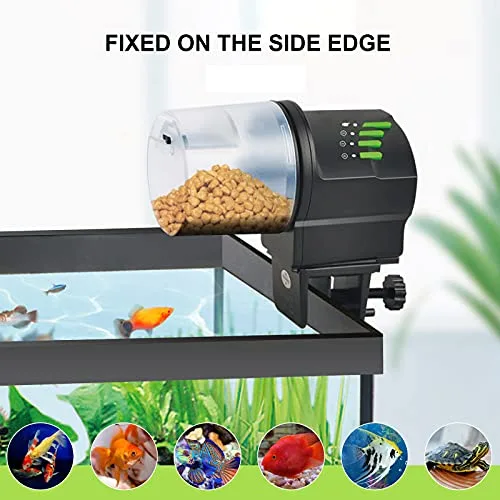
When you hold the unit, it feels lightweight. It is made entirely of plastic, which is standard for this price range, but the mounting bracket gave me pause. It uses a plastic screw to tighten against the glass. On my rimless tank, this was fine, but I worried about over-tightening it and snapping the plastic thread. It doesn’t feel like heavy-duty equipment.
The Drums (Containers):
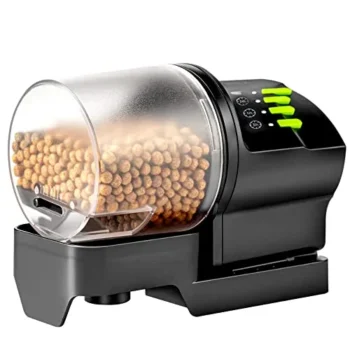
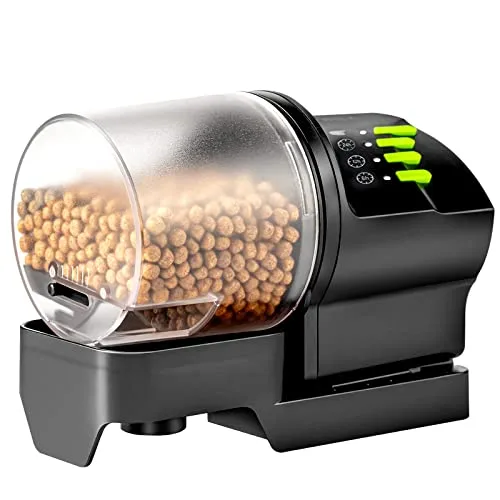
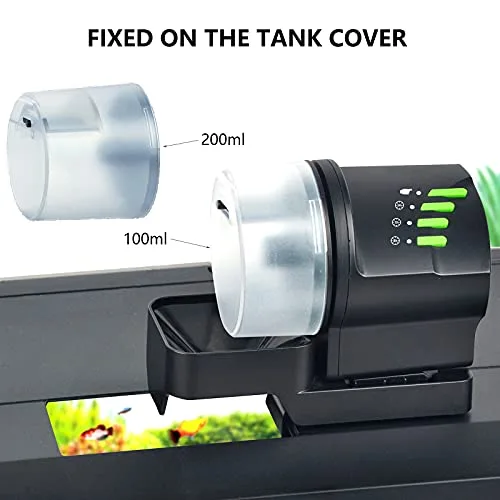
I appreciated that DXOPHIEX includes two different container sizes (100ml and 200ml). Switching them out is easy—they just snap onto the motor gear. The plastic is transparent enough that I could see exactly how much food was left without opening it, which is a small but annoying issue I’ve had with opaque feeders in the past.
The Buttons:
The interface is minimal. You have physical buttons for manual feeding and the time intervals, accompanied by small LED indicators. They are clicky and responsive, not mushy. However, because there is no LCD screen, you rely entirely on those little LEDs to know what mode you are in.
⚙️ Real-World Performance
I mounted this on a 20-gallon planted tank stocked with Tetras and a Betta. Here is how it handled the daily grind.
Feeding Consistency
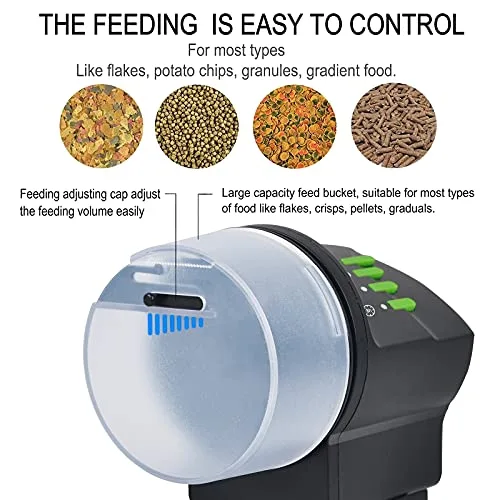
I filled the 100ml drum with a mix of flakes and micro-pellets. The adjustable slider on the dispensing gate is tricky. You have to slide it open *just* enough to let food out, but not so much that you dump a week’s worth of food in one go.
During my first test run over a sheet of paper, the first dump was huge. I had to nudge the slider back almost to the closed position. Once I dialed it in, it was relatively consistent, but I noticed that flakes tend to tumble out unpredictably compared to round pellets. If you use large flakes, you might find the feeder getting clogged or dropping uneven amounts.
The Moisture Issue
This is the enemy of all auto-feeders. Evaporation from the tank rises and turns fish flakes into a soggy, moldy brick inside the drum. I ran this for a week over an open-top tank. While the food didn’t turn to mush, the flakes did start to stick slightly to the sides of the drum by day 5. Pellets remained completely dry. If you have a tank with a lot of surface agitation and spray, you need to mount this as high up as possible.
The Feeding Ring
I actually love that they included a 4×4 inch feeding ring. It seems like a cheap throw-in, but it makes a huge difference. Without it, the auto-feeder drops food and the filter current immediately blows it all over the tank, often sucking it into the skimmer before the fish eat. The ring kept the food contained directly under the drop zone, giving my Tetras time to eat before the current took over.
⚠️ The Downsides (Critical)
It’s not all smooth sailing. Here are the things that frustrated me during testing:
1. The Mounting Clamp is Weak
The “stent” (clamp) feels flimsy. When I tried to mount it on a tank with a plastic rim (standard Aqueon style), the clamp struggled to get a wide enough grip. It wobbled. If you have a thick rimmed tank, you might have to use the included Velcro/funnel base instead, which I find messy and less secure. I wouldn’t trust the Velcro adhesive over a tank full of water for long periods.
2. No “Real Time” Clock
As mentioned earlier, the timer is based on intervals from when you press the button. If the power goes out and the batteries take over, it keeps the schedule. But if you accidentally hit the button or need to change batteries and don’t have USB backup, the timer resets. You can’t just tell it “Feed at 9 AM.” You have to physically wait until 9 AM to set it. It’s annoying if you have a busy morning schedule.
3. The USB Cable Length
They provide a 6.6ft cable, which sounds long, but for many aquarium setups where the stand is tall and the outlet is near the floor behind furniture, it was a tight stretch. I ended up needing an extension cord. It’s a minor gripe, but cable management with a wired feeder on top of a tank is aesthetically messy.
📊 Pros/Cons Table
| 👍 What I Liked | 👎 What I Didn’t Like |
|---|---|
| Dual Power Safety: USB with Battery backup is a lifesaver for vacations. | Interval Timer: Cannot set specific clock times (e.g., 5:30 PM). |
| Silent Operation: I literally couldn’t hear it turning. | Flimsy Clamp: Feels insecure on thick-rimmed tanks. |
| Capacity Options: The 200ml drum holds enough for weeks. | Flake Clumping: Moisture can still affect flake food over time. |
| Included Feeding Ring: Prevents food from polluting the filter. | Cable Management: Having a wire running up to the tank hood looks messy. |
⚔️ Head-to-Head: DXOPHIEX vs. Eheim Everyday Feeder
The Eheim Everyday Fish Feeder is arguably the most famous competitor in this space. I’ve owned two Eheims for years. How does this DXOPHIEX stack up?
Control: 🏆 Eheim wins. The Eheim has a digital LCD screen. You can program exact times and multiple rotations per feed. The DXOPHIEX is stuck with simple 8/12/24h intervals.
Power: 🏆 DXOPHIEX wins. Eheim is battery only. If the batteries die, it stops. The DXOPHIEX hybrid USB/Battery system is objectively safer for long trips.
Ventilation: 🏆 Eheim wins. The Eheim has a built-in fan system that actively ventilates the food drum to keep flakes dry. The DXOPHIEX relies on passive air, which makes it more prone to clumping if you use flakes.
Price: 🏆 DXOPHIEX wins. It is significantly cheaper and includes the feeding ring, which Eheim does not.
👨⚖️ Expert Verdict
After two weeks of testing, my feeling is that the DXOPHIEX Automatic Fish Feeder is a “peace of mind” device rather than a precision instrument.
Who is this for?
This is for the aquarium owner who is terrified of battery failure while on vacation. If you are leaving for 10 days and want a guarantee that the feeder will still have power, this is the one to buy. It is also great for pellet users and people with rimless tanks.
Who should avoid it?
If you are a control freak who needs feeding at exactly 7:15 AM and 6:45 PM, skip this. Get a feeder with a digital clock. Also, if you exclusively feed large, soft flakes in a humid environment, you might struggle with food clumping in this drum.