Jessica
At WeLovePetz, we are dedicated to providing you with the best pet care tips.
OPERATION: DINNER DIPLOMACY
The PETLIBRO RFID Feeder – How a $200 Robot Ended My Cats’ 5-Year Food War and Revolutionized Multi-Cat Management
MISSION INITIATED: ACQUISITION PROTOCOL
DEPLOY UNIT(Cost-benefit analysis: $200 vs. 1,825 days of conflict. Mission approved.)
MISSION BRIEF: THE TECHNOLOGY STACK DECODED
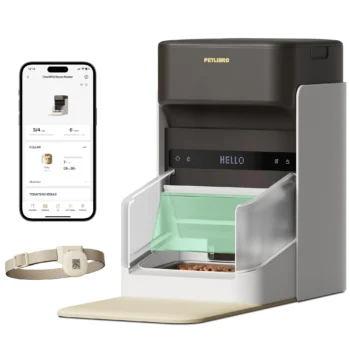
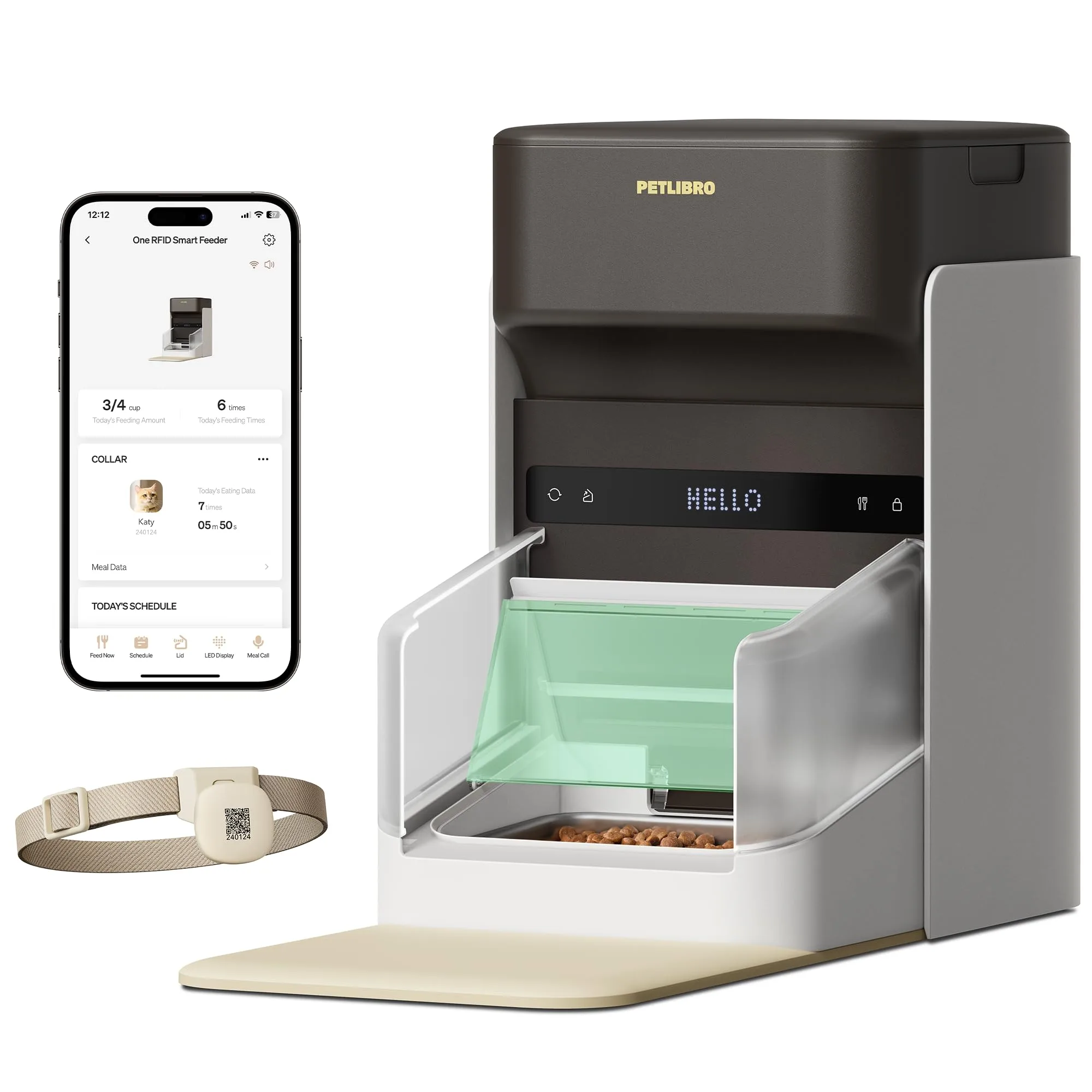
This isn’t a feeder. It’s a biometric access control system for kibble. Forget timers and gravity. This uses RFID (Radio-Frequency Identification) – the same passive, short-range tech that gets you into secure office buildings or pays for your subway ride. Each cat gets a lightweight (4-gram) collar tag (their “key card”). The feeder’s arch contains a scanner. Approved tag detected? Lid opens with a soft whir. Tag absent? Lid locked. It’s that simple. That brilliant.
The PETLIBRO One (its official name) represents a fascinating convergence of pet tech trends: IoT connectivity, precision portioning, and behavioral monitoring. It’s not the first selective feeder (SureFeed holds that crown), but it’s arguably the first to combine selective access with fully automated meal dispensing at this price point, creating a true “set and forget” system for multi-diet households.
Under the hood, the technology is elegantly straightforward. The RFID system operates at 125 kHz, a frequency chosen for its reliability and short read range (perfect for preventing “drive-by” eating). The tag contains no battery; it’s energized by the scanner’s electromagnetic field, then broadcasts its unique ID. This lack of moving parts in the tag makes it durable and waterproof. The feeder itself houses the brain: an ARM-based microcontroller, Wi-Fi module, precision load cell for weighing food, and the geared motor that controls both the dispensing mechanism and the lid.
UNBOXING, SETUP, AND THE 72-HOUR TRAINING PROTOCOL
The unit arrived with substantial heft—just over 7 pounds. Matte white plastic, clean lines, no visible screws. It looked like something from Apple’s pet division, not a pet store. Packaging was meticulous, with each component (power adapter, collar tags, desiccant box) nestled in custom foam. First impressions matter, and this screamed “premium.”
Setup was unnervingly smooth, a stark contrast to my usual IoT struggles. The dual-band Wi-Fi (2.4G & 5G) connected instantly via the PETLIBRO app (available on iOS and Android). The app asked me to name the feeder, calibrate it with my specific kibble size (small, medium, large), and perform a test dispense. It dispensed a few portions, weighing each internally, learning the exact mass-to-volume ratio of my cats’ particular food. This calibration is critical—it’s what allows the app to track consumption in grams, not “portions,” providing true nutritional data.
CRITICAL DATA POINT: THE BEHAVIORAL TRAINING PROTOCOL
You cannot drop this futuristic monolith in front of a cat and expect compliance. The lid makes a soft, mechanical whir—a novel and potentially frightening sound. Luna froze, ears flattened. The app’s “Training Mode” was our salvation. This feature lets you: 1) Keep the lid permanently open, 2) Adjust open/close speed to “slow,” and 3) Enable a friendly, quiet beep from the collar tag when scanned. We began with the lid permanently open and food in the bowl, letting the cats associate the unit with food. Day 2: lid opens slowly when Luna’s tag is detected. Day 3: normal operation speed. Total acclimation: 72 hours. Patience is not a virtue here; it’s mandatory ammunition. Rushing this phase can create a negative association that takes weeks to undo.
The collar tags are the system’s linchpin. They’re lightweight (my cats, used to breakaway collars, didn’t even notice them), but the attachment is a simple split ring. For cats prone to losing collars, this is a noted vulnerability. PETLIBRO includes two tags, and more are available for purchase. The tag must be positioned on the top of the neck for reliable scanning; side or chest mounting often fails. We had one instance of a “missed scan” because Luna approached at an extreme angle; repositioning the tag solved it.
THE BREAKTHROUGH: FIRST CONTACT AND DATA REVOLUTION
RFID GATEKEEPING IN ACTION
The scanner reads the tag from about 4-6 inches away. Luna approaches, a soft beep from her collar, the lid glides open. She eats. Nova saunters over, curious. The lid remains sealed. She sniffs the closed plastic, tries to paw it, even attempts to stick her head under the arch. Nothing. She looks at me, betrayed. The food thief has been firewalled. The psychological shift was immediate. Luna, no longer stressed, began eating more slowly and completely. Nova, frustrated at first, eventually learned her access was denied and began waiting for her own scheduled dispense at her own bowl (a regular automatic feeder).
THE DATA SURVEILLANCE ADVANTAGE
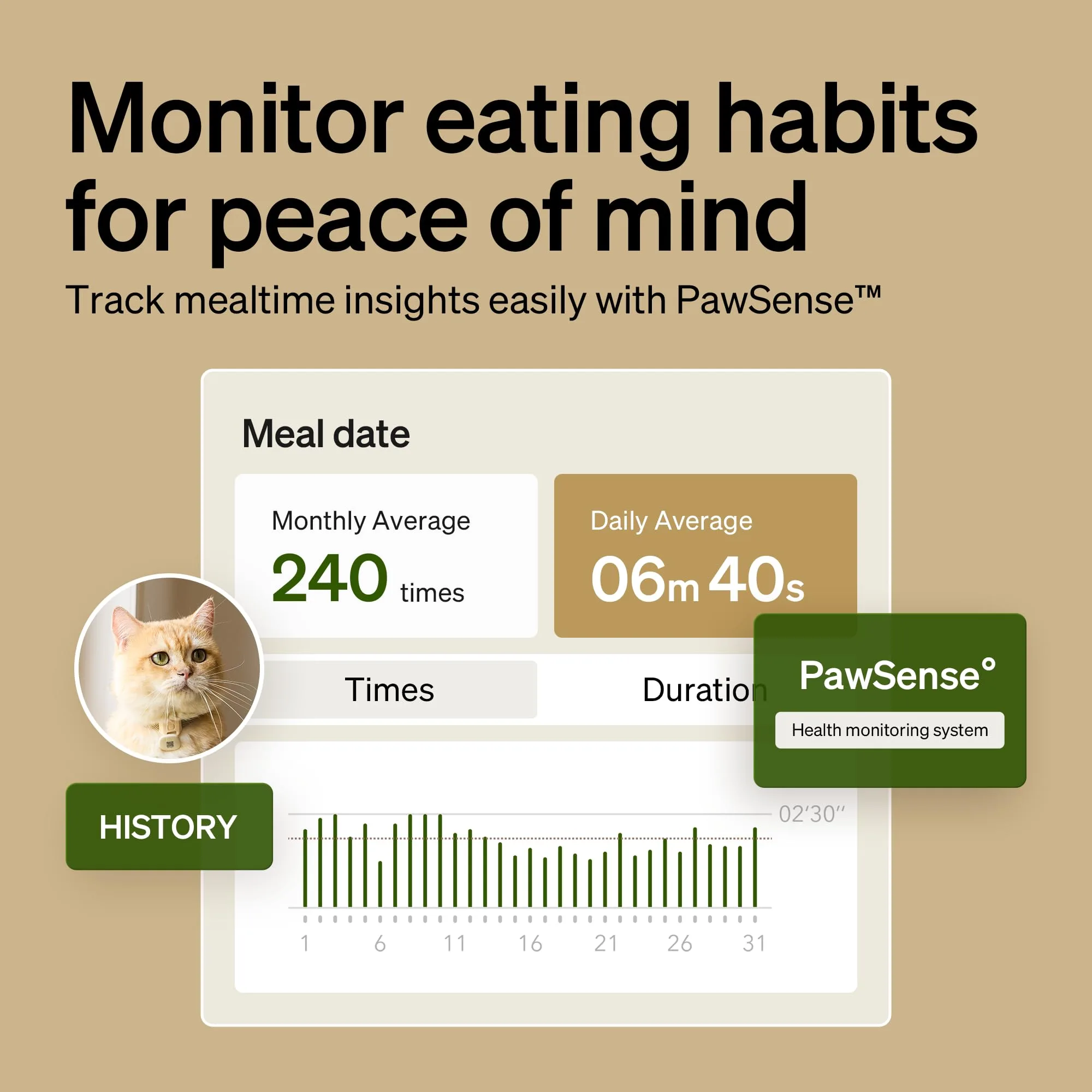
This is the silent killer feature. The app doesn’t just say “food dispensed.” It logs with timestamps: “Luna ate 12g at 08:07. Meal duration: 4 min 22 sec.” I now know Luna prefers to graze at 3 AM (nocturnal nibbler). I know Nova eats 90% of her food within 2 minutes of dispensing (confirmed glutton). I can track weekly consumption trends. This isn’t feeding; it’s health intelligence. A sudden drop in consumption is the first sign of many feline illnesses. Previously, I’d have to guess. Now, I have a data log to show my veterinarian.
FRESHNESS PROTOCOL & HYGIENE
Five-layer sealing: silicone gaskets on the lid, a replaceable desiccant box in the hopper, an airtight rotating dispensing chamber, the RFID lid itself, and a sealed hopper lid. The kibble in the bowl after 12 hours smells and crunches exactly like kibble fresh from the bag. Pickiness neutralized. The bowl is removable and dishwasher safe. The lack of food smell buildup (thanks to sealing) also seems to reduce the feeder’s attractiveness to ants, a previous kitchen issue.
The app’s interface deserves praise. It’s clean, intuitive, and information-dense without being cluttered. You can set up to 10 meals per day per pet, with portion sizes adjustable in 1-gram increments. You can also manually dispense food remotely—a godsend when running late. Notifications are customizable: low food alerts, missed meal alerts, feeding completion alerts. I turned on “missed meal” alerts for peace of mind when away overnight.
STRATEGIC ANALYSIS: DEEP DIVE INTO ASSETS & VULNERABILITIES
TACTICAL ASSETS (PROS)
- Absolute Food Segregation: For multi-diet homes, this is the holy grail. Prescription food stays with the prescribed cat.
- Unprecedented Data: Consumption logs are transformative for weight management and early illness detection.
- True Automation: Fills the hopper every 4-5 days. Combined with a water fountain, enables worry-free weekends away.
- Build Quality: Dense, sturdy plastic. Motor sounds are quiet and premium. No flimsy parts.
- App Reliability: In 4 months, zero crashes or failed connections. Notifications are timely and accurate.
- Freshness System: Works as advertised. Food stays remarkably crisp, even in humid environments.
- Battery Backup: 4 D-cells power the logic and motor during outages, ensuring schedule adherence.
IDENTIFIED VULNERABILITIES (CONS)
- Collar Tag Dependency: The system’s greatest weakness. Tag loss or a cat that refuses collars renders it useless.
- Bulk & Footprint: It’s large (11.8″ x 8.7″ x 13.4″). Not ideal for small apartments or crowded countertops.
- No Microchip Option: A conscious trade-off. The competing SureFeed reads implanted chips but requires manual daily filling.
- Price Point: At ~$200, it’s a significant investment. Justifiable, but a barrier for some.
- Learning Curve: Requires a 2-3 day training period. Not “plug and play” for the cat.
- Potential for “Tailgating”: A determined second cat could theoretically rush in as the lid closes, though we’ve never observed it.
- D-Cell Batteries Not Included: A minor but annoying omission for a premium product.
“The moment I saw Nova give up and walk away from Luna’s bowl was the moment I knew this was different. It wasn’t just a machine saying ‘no.’ It was the environment itself enforcing the rule. The frustration left her face within a week, replaced by a calm acceptance. She learned the new law of the land faster than I did.”
READY TO DEACTIVATE THE FOOD WARS?
INITIATE PEACE PROTOCOLRecommendation: Purchase backup collar tags immediately. And a pack of high-quality D-cell batteries.
FREQUENTLY QUERIED PARAMETERS: EXPANDED INTELLIGENCE
This is the system’s primary failure point. The feeder comes with two tags. Additional tags are available for purchase (approx. $15-$20 for a two-pack). The tag is lightweight and clips to any breakaway collar. If lost, you can deactivate the lost tag in the app and activate a new one immediately. For collar-averse cats, this feeder is likely a non-starter. Some users have had success attaching the tag directly to a harness for supervised meal times, but this negates the automation. Consider your cat’s collar tolerance before purchasing.
The lid is motorized and locks with a satisfying *clunk* via a small internal latch. It’s not pry-able by paw. A truly persistent, large cat might attempt to tip the entire unit over (it’s stable but not bolted down), but the hopper lid also locks separately. In our 4-month stress test with Nova, a master thief, she has not breached it. She has learned that effort is futile. The system’s “hack” would be “tailgating”—a second cat slipping in as the lid closes. This requires precise timing and we haven’t witnessed it. The lid close delay is configurable (2-15 seconds), allowing you to minimize this window.
It has robust battery backup (4 D-cells, not included). If AC power fails, the batteries seamlessly take over, keeping the clock, schedule, and RFID logic running. They can also power the dispensing motor and lid motor for hundreds of cycles. If Wi-Fi goes down, it continues its scheduled dispenses and RFID checks locally based on its internal clock. You just lose remote app access, live logs, and notifications until connectivity is restored. All feeding activity during the outage is stored locally and syncs to the app when Wi-Fi returns.
Break it down practically: Luna’s prescription urinary food costs $85 for an 8lb bag. Nova stealing and vomiting it was wasting roughly 1/3 of the bag monthly—about $30. That’s $360/year in pure waste. The feeder paid for itself in under 7 months on food savings alone. Add the value of: 1) Eliminated vet bills from stress-related cystitis (Luna’s history), 2) Regained personal time (1 hour daily x 365 = 365 hours/year), 3) Health monitoring data (priceless for early intervention), 4) Peace of mind for weekend trips. For a multi-cat, multi-diet household, it’s not an expense; it’s a high-yield investment in domestic peace.
This is the crucial decision. PETLIBRO RFID One: Pros = Full automation (5L hopper), app control, consumption data, scheduled meals. Cons = Requires collar tag, no microchip reading, larger footprint. SureFeed Microchip Pet Feeder: Pros = Reads existing microchip or included tag, no collar needed, simpler, often preferred for extremely timid cats. Cons = NO AUTOMATIC DISPENSING. You must fill the bowl daily. It’s just a smart covered bowl. The choice: Do you want a smart bowl (SureFeed) or a smart, automated restaurant (PETLIBRO)? For true automation and multi-day independence, PETLIBRO wins. For chip reading and ultimate simplicity, SureFeed wins.
Exceptionally well. The calibration process asks you to select kibble size (Small, Medium, Large). It then dispenses a few test portions and weighs them internally to create a precise “grams per portion” model. We’ve used it with tiny urinary kibble (6mm) and large dental kibble (12mm) without issue. The rotating dispensing mechanism uses fins to scoop food, which handles most shapes. Very oddly shaped or extremely sticky (coated) kibble could potentially cause jams, but in mainstream commercial diets, this hasn’t been a reported problem.
MISSION STATUS: ACCOMPLISHED
Four months into the PETLIBRO Era, the dinner war is archived history. The kitchen is quiet at feeding time. Luna eats her urinary food, undisturbed, in multiple small grazes. Nova eats her weight control food, unable to cheat, learning patience. The feeder dispenses, scans, logs, and secures with quiet efficiency. I monitor their health from my phone like a mission control specialist, watching for dips in Luna’s 3 AM snack or changes in Nova’s feeding speed.
This device isn’t a pet feeder. It’s a conflict resolution system. It uses 21st-century technology—RFID, IoT, precision engineering—to solve a primordial problem: resource competition within a social group. It doesn’t just feed cats; it manages them. It provides objective data where there was once only subjective anxiety and guesswork. It externalizes the enforcement of rules, removing the human from the role of constant referee.
The PETLIBRO RFID Feeder represents a significant leap in accessible pet tech. It’s not without its compromises (the collar tag requirement is real), but for the right household—specifically, multi-cat homes with dietary restrictions, food thieves, or humans craving data and automation—it is nothing short of revolutionary.
It didn’t make my cats like each other. But it made sure their fragile treaty over the most valuable resource in their world—the food bowl—is permanently, impartially, digitally enforced. The war is over. The Diplomacy Protocol is active.
Disclaimer: I am a passionate pet owner and technology enthusiast, not a veterinarian or engineer. This article is based on approximately 120 days of hands-on testing and research. Individual results may vary based on pet personality, home environment, and specific dietary needs. The Amazon link is an affiliate link, which means I may earn a small commission if you purchase through it at no extra cost to you. This helps support independent, in-depth reviews like this one. Always consult your veterinarian for dietary and health advice for your pets.
Authors